When a major championship comes to town, the competition you see on television is only part of the event. Behind every broadcast camera, every on-course commentary position, every interview microphone, and every two-way radio carried by an operations crew, there is an invisible layer of infrastructure that has to work flawlessly: the radio spectrum.
At the 2026 PGA Championship, Broad Comm served as the RF frequency coordination team responsible for keeping that layer clean. It was also the first live event run on our newly upgraded coordination portal — and the championship gave the new system exactly the kind of high-stakes, high-density environment it was built for.
Why RF coordination matters at a championship
A modern golf championship is one of the most demanding wireless environments in live sports. The course itself can span well over a hundred acres, and across that footprint hundreds of wireless devices need to operate at the same time without stepping on one another.
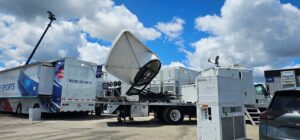
Broadcasters bring RF cameras, tower cams, and POV systems, along with wireless microphones for on-course commentary and the microwave and satellite links that carry the feed off-site. Tournament operations rely on two-way radios and wireless intercom systems. Add in-ear monitoring for talent, telemetry for scoring and course measurement, public safety communications, and the private wireless systems that increasingly support event logistics, and the spectrum fills up quickly.
When two devices are assigned conflicting frequencies, the result is interference — a dropped camera shot at the wrong moment, a commentator’s microphone cutting out, a radio call that never reaches its destination. At a championship watched by a global audience, there is no margin for that. Frequency coordination is the discipline of assigning every device a clean, conflict-free channel before the event begins, and then protecting those assignments while the event is underway.
Broad Comm has performed this work at the highest level of credentialed events for decades, and we approached the PGA Championship with the same priority order that has always guided us: licensed and broadcast users come first. Broadcast trucks, wireless microphones, licensed microwave links, and core event communications are protected, and every other request is coordinated around them.
A new portal, proven under pressure
The 2026 PGA Championship marked the debut of Broad Comm’s upgraded frequency coordination portal — a centralized system that gives every partner, broadcaster, vendor, and contractor a single place to register equipment and request frequencies before they arrive on grounds.
The old way of doing this work was effective but heavy on manual effort. The new portal was built to make registration faster and easier for the people using it, while giving our coordination team a far more complete and structured picture of the wireless landscape going into the event. Key elements include:
- Self-service account setup with multi-factor authentication, so every registration is tied to a verified user and organization.
- Equipment registration that lets organizations enter devices individually or upload larger inventories in bulk.
- Event-based frequency requests, so each device is matched to a specific event and a specific clean channel rather than a generic allocation.
- Coordinated confirmations, giving each user a clear summary of their approved frequency assignments.
A first deployment at an event of this magnitude is a real test, and the portal performed. Registrations came in ahead of the event, the coordination team had structured data to work from rather than a scramble of last-minute requests, and users had a clear, guided path to getting on the air legally and cleanly.
One thing we made a point of preserving: the human side of the service. A portal makes the process more convenient, but it does not replace people. Our coordination team was on-site throughout the championship, working from the Media Center, available to solve problems in real time — and yes, we still issued the stickers that crews have come to expect.
What the new system unlocks
The value of a centralized portal is not only convenience. Better data in means a smoother, more reliable process for everyone involved.
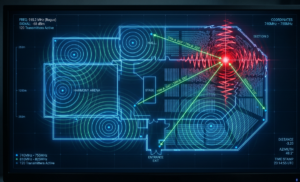
Because registrations now arrive in a consistent, structured format ahead of the event, our team is better prepared from the moment crews arrive on grounds, and able to respond faster when something needs to change on-site. Spectrum monitoring runs throughout the event, and when the registered picture is complete and accurate, that monitoring is far more effective — anything that appears on the air and shouldn’t be there is easier to identify and resolve.
For event organizers and rights holders, that translates into something straightforward: a more reliable broadcast, fewer interference incidents, and a coordination process that scales as wireless demand at events continues to grow.
Looking ahead
The PGA Championship was the first event on the upgraded portal, and it won’t be the last. The same system now supports frequency registration across our 2026 event calendar, and each deployment makes the platform stronger.
The wireless environment at major events keeps getting denser, not simpler. More cameras, more wireless audio, more private networks, more devices of every kind. Coordinating all of it — and protecting the licensed and broadcast users at the center of it — is the work Broad Comm exists to do. The 2026 PGA Championship was a strong proof point that our upgraded approach is ready for it.
Broad Comm provides mission-critical RF frequency coordination and spectrum management for major credentialed events. To learn more about coordination for your event, visit broad-comm.com or book a consultation with our team.