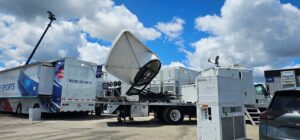
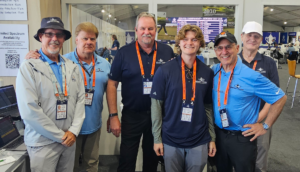
Ask any production manager what they worry about at 6 a.m. on show day, and wireless will be on the short list. Microphones, in-ear monitors, IFB, wireless cameras, intercoms, two-way radios, public safety channels, broadcast links — every one of those systems lives in the same finite pool of radio frequencies. When they’re coordinated, nobody notices. When they’re not, everybody does.
That invisibility is the point. Great frequency coordination looks like nothing happening. No dropped audio during the national anthem. No hot mic bleeding into a broadcast feed. No rogue vendor knocking out a camera link ten minutes before air. At Broad Comm, we’ve delivered more than 50 major events per year for over five years with zero on-air hits — and that number exists precisely because the work is invisible when it’s done right.
What frequency coordination actually is
Frequency coordination is the engineering discipline of assigning, monitoring, and enforcing radio channel use across every wireless device operating within a venue or event footprint. It’s part math, part database work, part field engineering, and part diplomacy with the dozens of vendors, broadcasters, and agencies that show up to an event with their own gear.
A proper coordination effort has four pillars:
- Inventory — every transmitter, its power, its location, its schedule of use.
- Channel assignment — clean frequencies calculated to avoid intermod products, harmonic interference, and overlap with licensed local users.
- Registration and credentialing — so only coordinated devices are authorized to transmit on site.
- Live monitoring and enforcement — spectrum analyzers, direction-finding, and a team that can physically locate and shut down a rogue emitter in minutes.
Why it matters more every year
The RF environment at a modern event is denser than it has ever been. LTE and 5G coexist with broadcast auxiliary service frequencies. IoT sensors, connected vehicles, wearable cameras, and drones all want spectrum. At the same time, the FCC has reallocated chunks of the 600 MHz and 700 MHz bands that wireless microphones used to rely on, pushing coordinators into tighter, more crowded territory.
The result: the same event that ran ten wireless microphones a decade ago now runs fifty, and they’re sharing space with networks that didn’t exist back then. Coordination isn’t optional anymore — it’s the only reason any of it works.
Three RF tips you can apply this week
Whether you’re running a small corporate AGM or prepping for a stadium event, these habits separate professional wireless from the stuff that gets unplugged at 3 a.m.:
- Start your spectrum audit early. Two weeks out is late. Six weeks out is about right for a mid-sized event — you want time to identify local licensed users, request coordination with neighboring venues, and model interference before you’re locked into gear choices.
- Log every transmitter, even the ones ‘somebody else is handling.’ The device that causes the problem is almost always the one nobody wrote down.
- Treat your coordination plan as a living document. Gear changes, vendors swap units, and someone always shows up on show day with a spare mic nobody scanned. Build a registration process that forces late additions through the same door.
The bottom line
Frequency coordination is the infrastructure underneath the infrastructure. It’s why the talent sounds clean, why the broadcast doesn’t pop, and why the public safety radios keep working when something goes sideways. The venues that treat it as a line item get away with it until they don’t. The ones that treat it as a discipline keep doing business.
Work With Broad Comm Planning a major event this year? Broad Comm has delivered clean spectrum across 50+ major events per year with zero on-air hits in over five years. Book a consultation at broad-comm.com and let our RF War-Game™ engine stress-test your event before showtime does.