Every event-level wireless system has to work. Public safety systems have to work on the worst day of someone’s life. That difference changes everything about how they’re engineered.
When a security team needs to call for medical support, coordinate a crowd movement, or respond to an actual incident, the radio either works or it doesn’t. There is no retry. There is no ‘let me step somewhere with better signal.’ The channel has to be there, it has to be clear, and it has to stay clear while everything else around it is going sideways.
What ‘hardened’ actually means
Public safety comms are called hardened channels for a reason. Hardening isn’t one thing — it’s a stack of design decisions, each one closing a specific failure mode.
- Dedicated spectrum. Public safety channels don’t share with broadcast or vendor operations. The guardbands are wider, the power budgets are higher, and the frequencies are protected from the chaos happening elsewhere on the event.
- Physical separation. Primary and backup antennas live on different structures, with different power feeds and different cable paths, so a single equipment failure can’t take both down.
- Redundant repeaters. Two or more overlapping repeater systems cover the venue footprint. If one drops, the other carries the traffic with no operator intervention.
- Independent power. Hardened systems have their own UPS, their own generator circuit, and tested cutover — because losing commercial power is exactly when radios matter most.
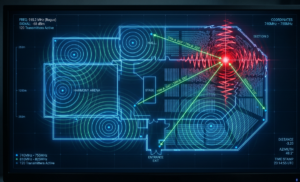
- Continuous monitoring. A hardened channel that nobody is watching is just a channel. Real-time spectrum monitoring confirms the frequency is clean, the repeater is up, and the coverage footprint still matches design.
Fail-over: the work you hope nobody ever sees
The word to remember about fail-over is transparent. A well-designed public safety fail-over happens without the radio user noticing — they key their mic, the traffic goes through a backup path, the response happens. The moment an operator has to think about which system they’re on, the design has already failed.
That invisibility takes work. It means pre-programmed alternate talk groups, automatic roaming between repeater sites, tested cutover procedures, and — critically — exercises. A fail-over path that hasn’t been drilled is a fail-over path that won’t work when it has to.
Credentialed events and the compliance layer
Events with federal protection add another dimension to comms design. When the Secret Service is running a protective detail, every transmitter inside the perimeter is a potential interference source for the protective agents’ radios. Coordination there isn’t a best practice — it’s a mandatory part of credentialing.
Broad Comm sits on the U.S. Secret Service Spectrum Deconfliction Committee precisely because these environments demand a deeper engineering discipline than typical event coordination. The same principles apply at a smaller scale to any event with elevated security needs: dedicated channels, tested redundancy, documented enforcement, and real-time monitoring that integrates with the security operations center.
Three fail-over principles you can apply
- Assume the primary will fail. Design your backup to carry full traffic on its own, not as a degraded mode. If the backup can only handle half the load, you have half a backup.
- Physically separate your paths. Two pieces of gear on the same power strip are not redundant. Two antennas on the same mast are not redundant. Redundancy requires independence.
- Drill the cutover. Run a live fail-over during rehearsal. If it doesn’t work in a controlled environment, it definitely won’t work during an incident.
The bottom line
Public safety communications are the last line. When they work, nobody thinks about them. When they don’t, no amount of preparation elsewhere on the event can compensate. Designing comms that don’t quit is less about any single piece of technology than about a discipline of layered, tested, monitored redundancy.
Work With Broad Comm If your next event needs bulletproof wireless — comms, broadcast, IFB, IEM, public safety — it’s time to talk to the team that sits on the U.S. Secret Service Spectrum Deconfliction Committee. Reach out at broad-comm.com to schedule a War-Game prep call.