The broadcast truck is one of the most spectrum-hungry boxes on the planet. Camera links, wireless audio, IFB to on-camera talent, intercoms, teleprompter signals, and the microwave or bonded-cellular uplink pushing the whole show back to the network — all of it running simultaneously, all of it needing to stay clean from first-take to last.
For a broadcaster, RF interference isn’t a technical inconvenience. It’s a credibility problem. A dropped word from a play-by-play announcer, a buzz on a sideline interview, a blackout on a wireless camera during a critical moment — those are the clips that go viral, and nobody who works in broadcast wants the wrong kind of viral.
What makes broadcast environments uniquely tough
Three factors compound at broadcast events in ways they don’t at most others.
First, density. A single live sports broadcast can put dozens of wireless devices into the air at once — handhelds, lavs, IFB, camera RF, intercoms — all sharing space with the venue’s house systems, the league’s in-stadium production, and the competing rights-holders if the event has them.
Second, geography. Broadcast events travel. The coordination plan that worked at one stadium has to be re-engineered for the next, because the local licensed users, the neighboring venues, and the ambient RF floor are all different.
Third, stakes. A live broadcast has no second chance. If wireless audio drops during a kickoff, the network isn’t going to reshoot the kickoff. The coordination either held or it didn’t.
Where coordination quietly saves the broadcast
Good RF coordination on a broadcast shows up as an absence. No audio dropouts. No color-commentator headsets cutting out. No wireless camera freezing on a reverse angle. The coordinator’s fingerprints aren’t visible, which is precisely the outcome everyone is paying for.
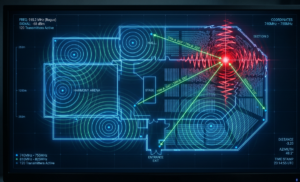
Under the hood, the work is meticulous. Every camera channel is coordinated against the venue’s BAS users. Every IFB frequency is modeled against the in-ear systems on the field and in the booth. Wireless handhelds and lavs are assigned across the band with enough guardbands to survive real-world Doppler and body attenuation. And every transmitter is logged, tagged, and enforceable.
Three broadcast-specific RF tips
- Coordinate early with the venue’s in-house systems. Stadiums, arenas, and convention centers run their own RF that the visiting broadcaster usually doesn’t see on paper — scoreboard audio, referee comms, vendor radios. Ask for the complete list before you assign anything.
- Reserve frequency margin for the unplanned. Live broadcast always invents new requirements on the day — a last-minute sideline shot, an extra lav, a surprise guest. If you planned your spectrum to the edge, you have nowhere to put them.
- Monitor throughout the broadcast, not just during setup. The ambient RF environment shifts as the crowd fills in, as phones connect, as nearby facilities cycle through their own wireless use. The channels that were clean at 9 a.m. aren’t necessarily clean at kickoff.
Why broadcasters come back to Broad Comm
We’ve built our coordination practice around the reality that broadcasters can’t afford to gamble. Our RF War-Game™ process models the full broadcast package — cameras, audio, IFB, intercom, uplink — against the venue environment before load-in, and our on-site enforcement team neutralizes rogue hits in under 90 seconds. Zero on-air hits in over five years isn’t a marketing line; it’s the outcome of treating every broadcast as if a single drop will end someone’s career.
Work With Broad Comm If your next event needs bulletproof wireless — comms, broadcast, IFB, IEM, public safety — it’s time to talk to the team that sits on the U.S. Secret Service Spectrum Deconfliction Committee. Reach out at broad-comm.com to schedule a War-Game prep call.